Showing posts with label Tanzania. Show all posts

Sunday, November 28, 2010

PW Students Visit Amahoro Secondary School

Last week, Lucas passed through Kiganza village en route to Mgaraganza village to collect more pictures of the school.  On his way, he picked up some of the Project Wezesha students who were making the long journey home from school in Mwandiga.  For those that live in Kiganza village, such as Hindu, Edina, Ismael and Diana, that trek is about an hour long on foot.  For those that live in Mgaraganza, there is another 30 minutes through the forest to get home - that impacts Zainabu, Silvasia and Khadija. 

On this sunny day, Lucas invited all of them to go the extra distance through Mgaraganza village to the school building site to see the progress. They wandered through the lush forest (rainy season just passed) and up to the school where they were so excited to see the progress. Along the way, they also picked up Matamshi and Judith, two of our students who go to secondary school in Kagongo village. In this picture, they are crossing the river that divides Kiganza village and Mgaraganza village.
 
Crossing the River that borders Kiganza and Mgaraganza Villages


The Kiganza crew heading up from the river

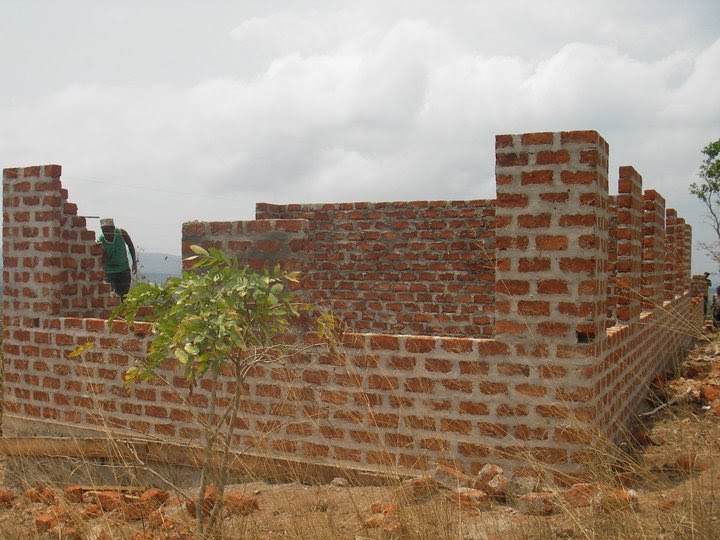
 Lucas told me on the phone this morning that they were all so happy about the school, even though most of them will be finishing secondary school in Mwandiga.  It makes them happy to know this school will be here for new students.  They laughed, joked, talked about studying and even chipped in by carrying some bricks for the new classrooms that they've begun building.    


Happy to see the new school underway

Lucas and I talked about how several of them will be graduating at the end of the upcoming year from secondary school.  Their academic year starts in January, not September, so they'll start Form 4 at the start of 2011 and take exit exams in November of 2011.  Lucas gave them a mini-lecture or 'pep' talk in the shade of the trees about the importance of this year.  The students told Lucas that they needed some books if they were possibly going to pass those important exams.  Since they have the next 1.5 months off between school years, they want to have books and begin studying now.  So, Project Wezesha is buying them books to study the core subjects - Math, Swahili, English, Geography and Science.  Lucas also told them to stay focused on doing well this year and not only passing their exit exams, but doing very well on the exit exams so they can go to High School.  


The whole crew by the river in Mgaraganza - judging by the laughs,
they were being shy and Lucas was insisting on a picture!  Thanks, Lucas!

Secondary school is really only the beginning.  If students are fortunate enough to have support for secondary school, then they learn English - as the medium of all instruction is English at the secondary school level.  Primary school goes from Standard 1 thorugh 7; secondary school goes from Form 1 to Form 4; high school is Form 5 and 6.  After high school, they can apply for college or university.  Interestingly, a student who completes secondary school can be hired to teach at a primary school.  Someone interested in teaching at the secondary level must complete high school with a focus on a particular core teaching subject and pedagogy.  Teaching at high school and many other careers require specialized university or college training.  So - while secondary school education is a key stepping stone for a bright future, the road ahead will be paved with greater opportunities for each year of additional education. 

Given that Project Wezesha is only three years old and our first group of students will graduate next year, we have yet to see what will happen next in terms of their desire and ability to go on to high school.  Our hopes are high and the students are motivated toward this goal.  If their teachers and families support them in this final, critical push, then we'll be celebrating high school graduations before we know it! 

In the meantime, Lucas is their mentor and Project Wezesha is ensuring that they even have this opportunity in the first place.  We'll keep the updates coming and let you know how they're doing along the Form 4 journey.

Thursday, November 25, 2010

Giving Thanks-Asante-Urakoze!!

On this lovely Thanksgiving Day, I would like to give thanks to everyone who has made Project Wezesha a great success over the past year.  Lucas and I had a simple plan when we sat at the Sun City Cafe in Kigoma in July 2009.  We just wanted to give out scholarships to a handful of children who wanted to go to secondary school, but couldn't afford it. 

Now, only a year later, we are happy to be supporting 12 children in secondary schools in Mwandiga, Bitale and Kiganza villages.  We also have three young students awaiting test results who hope to join the program in January!  In addition, we are so happy to be building Amahoro Secondary School with the village of Mgaraganza.  So much went into making this all possible - and I give thanks for all of it! 

I give thanks for Lucas, my partner and co-founder - a key player in making all of this possible.  Lucas has worked so hard with the village government to make sure everything is accepted and approved by the village and feasible for Project Wezesha.  He tirelessly interprets for me when I am in Tanzania, negotiating with the Ministry of Education, the Land Management office, our builders and the villagers.  He is also actively involved in the lives of the students we support, ensuring that they have what they need from month to month - materials, uniforms, school fees and of course - good attendance.

I give thanks to all of my friends and family, friends of friends and everyone else who has supported Project Wezesha through charitable donations, volunteer hours, participation in our race event last year, spreading the word and providing encouragement along the way! 

The whole experience has been amazing and I'm so excited to share, on this day for giving Thanks, the following series of pictures sent this week by Lucas.  They have finished all but the roofs on the four classrooms and the headmaster's office.  So fabulous!! 

Lucas, Isaya (our builder) and I have recently decided to roll our current funds into the completion of two additional classrooms and the teachers' offices.  When that is finished, we'll move on to the roofs.  It's so exciting to see this project unfold faster than anticipated.  We're well on our way to having the first ever secondary school for Mgaraganza, Kagongo, Kigalie, Mtanga and Bubango villages! 

Thank you very much! Urakoze cane! Asante sana!


Sunday, September 26, 2010

September Update on Amahoro Secondary School

Welcome back for another quick update!  For those of you who are new to Project Wezesha, make sure to browse through the July blog entries as I spent three weeks in July 2010 working in Mgaraganza village and Kigoma town - making this happen - with my in-country director, Lucas Lameck.

I spoke with Lucas twice over the past couple of months.  We have a plan to chat with each other every other Sunday.  Thank goodness for Skype Mobile on my Droid!  Now staying in touch is easy!  (That sounded like a commercial, but I swear no one is paying me ... or this school would be finished by now.) 

Recent news from Lucas includes the following:

We recently hired a 'ranger' or guard to watch over the equipment and materials throughout the weeks and nights when no one is on-site working.  As the funds slow down, so does the progress.  The goal right now is to use the last of existing funds and buy the bricks needed to finish what we've started before the rainy season sets in.  Lucas also plans to see to it that the roof goes onto the classrooms before long.

We're also completing a small 'road' up to the building site to save money (and manpower) previously spent on the labor to carry heavy materials up a steep rocky path to the school site.  The cost of the road completion is minimal compared to the final projected savings once they're able to drive right up to the school with bricks, bags of cement, etc.

In other news from Lucas's end, there was skepticism from someone in a neighboring village about my commitment to the project ... but not surprisingly, this doubt has all but melted away as Project Wezesha has almost completely finished 4 classrooms and an office for Amahoro Secondary School in a record 3 month period.  Given the power and influence of this individual's voice, it's good that he can see I'm for real!  There is no room to wonder if the 'mzungu' will come through!  She did, with the help of many wonderful donors and supporters - and of course, a number one right hand man - LUCAS!

Lucas is doing great.  When I call him, it's 9 hours later than my local time, so he's usually sitting in his home with his mom, dad and sibs.  I can picture them all sitting around in the courtyard of their modest mud home - chatting in the dark, finishing up a simple dinner of beans and rice, under the stars with their ducks nestling close by.  He's been investigating what he needs to do (exams, etc.) to finish his own high school education.  Lucas finished secondary school, but has yet to finish the 2-3 years of high school that will open many doors for him in the future - including possibly affording him the opportunity to study in the US if he wishes.

Here are some pictures Lucas sent recently to show the progress on the school.  This work was completed less than two months after I left - at which point, little had been built.  So, Isaya and his crew have been working tirelessly!


Next step - more fundraising!  I'm definitely planning to host the 2nd Annual Empower 5k Trail Run in the Spring.  My friend Hadley also has a good friend who is also a world famous opera singer!  We're hoping for a winter show with the talented Alfie Boe right here in Salt Lake City!  Please contact me if you'd like to host your own fundraiser or help with those we plan for the upcoming year.  www.railiz@yahoo.com


Monday, June 28, 2010

US-Ireland-Italy-Egypt-Tanzania

This summer I have the great fortune of traveling with friends. Coming to Tanzania alone last summer was an adventure and made for some entertaining blog entries (I’m told) but it also made for mental exhaustion and some loneliness. This year, at this point, I am in the great company of Laura Fombona from Spain and Hadley Rampton from Salt Lake City, UT. Soon, I’ll be joined by Carter Jensen of Salt Lake City – if he continues to survive his many adventures … sleeping with hippos, rafting the Nile and climbing Mt. Kenya.

Summer 2010 - The journey began on June 19th with Hadley and I embarking a midnight flight from Salt Lake City. We spent the following day in Manhattan – walking around the upper East side, taking a stroll in Central Park, enjoying organic goodies in a cafĂ© on Lexington Ave and journeying back to the airport via taxi and subway – an adventure in itself in NYC. That night, we took another midnight flight that dropped us into Dublin, Ireland at 10am. We got a car and drove south to my cousins in Wicklow where we strolled along the harbor, enjoyed a cappuccino at the end of “main street” in Wicklow town and then rounded off the family home evening with two bottles of delicious red wine, stories, laughs and rosy cheeks.

The next day, after sleeping in much later than planned – Hadley and I set off in our little Twingo for Galway on the West coast of Ireland. Three hours after departure, we arrived and enjoyed meandering along the restaurant-packed, cobblestone promenade through the center – dodging over-priced options by diving into a small side street for fabulous Indian food. After filling up in Galway, we hopped back in the car and drove an hour and a half south to the Burren mountains and the Cliffs of Moher.


We took several pictures from the point and then planned to stretch our legs by walking along the cliffs – only to be sent back in our tracks by signs warning of ‘death by wind’ that has apparently taken its fair share of people into the sea below. There were also signs that read: Need someone to talk to? … followed by a toll free number …. Woah! So, out of respect for those who have lost their lives on the cliff (that’s what the sign asked of us) we decided not to hop over the short stone barrier and onto the well-worn path.
Being 9pm, having nowhere to sleep and approaching our 4am check in time in Dublin, we decided to just drive through the night, back to the East coast.

We stopped into a wee pub in a wee town for a wee cup of coffee on our way back across the wee island to the capital. The men – ranging in age from 18 to 80 – were bellied up at the bar, sipping their pints and puzzling over the two odd birds at the bar drinking coffee and talking with funny accents. Meanwhile, we couldn’t tell if they were speaking in English or Irish … Later, in Dublin, we walked along the River Liffey and spotted (as in “we gotcha if you fall”) young girls as they stumbled out of bars and off their high heels into more cobblestone streets surrounding Temple Bar… there was sure to be some trouble for someone in these early morning hours, but we sensible wise 'older' women would be enjoying hummus and falafel in a sober spot letting the drunks be drunks and the innocent become less so.

Don’t go yet – we’re still en route to Africa! From Dublin, we took a short flight to Rome, Italy. We arrived in the morning, took a bus to the Termini terminal and a metro to the station closest to our B&B. We arrived in time for a nap, followed by Cuatro Formaggio pizza under the light of the Coliseum. We slept long and hard that night, not stirring for a single moped or gladiator singing Juliet up to our fourth floor window … ok, there were no gladiators – but we would have ignored them if they had come. The next morning, we blew it a bit … left our trip to the airport a bit late and found ourselves taking subway and train to the airport, arriving wet from sweat, hot with panic and last to our gate … to find (thankfully) that our flight was departing 30 minutes late! Phew!! After one uneventful stop-over in Cairo for a snack and a glimpse of the Japan-Denmark World Cup match, we were on our way to Dar es Salaam, Tanzania!!! At long last …

We arrived to Dar in the early early morning and my favorite little hotel had sent a driver as planned – seeing him with my name on little sign and greeting him with a light, bright “Mambo” reminded me what I’ve been looking forward to in these past weeks. Ahhh, Tanzania! Our first day in the country, Hadley and I … well, we slept … all day! We were absolutely exhausted from our world travels thus far. Our batteries needed recharging lest we catch malaria just from the sight of a mosquito due to our tired little bodies’ inability to even think about fighting back. Once in the sleep marathon, I asked Hadley - "Is it ok that we haven't eaten or had a drink of water in 14 hours? Are we just lying here dying?" I was delirous of course.

After sleeping for about 20+ hours with a waking moment here and there, we were ready for our African adventures! Dar es Salaam, the city from which all government goings-on take place, but which is actually not the capital (Dodoma is – news to me!), is a joy and a pain. It was so similar to the past two years I’ve been here – but I’ve heard things are taking a turn for the worse with the rich getting richer and the poor … yes, you can finish that sentence. There are many street people – adults and children, many of whom come in from villages to find something better only to be greeted by the sidewalk. Street vending has been cut off (made illegal) and most businesses are run by Arab and Indian Tanzanians, leaving many of the black Tanzanians to work for them. I won’t be here long enough to make a study, but it seems grim and only to become more grim - and I had a good reference point for these perspectives found in the tales of a young American writer we met who is in Dar refining his novel on the 2000 TZ elections.

On our second day in Dar, our friend Laura arrived from Spain. Our adventures in Dar mainly consisted of logistics. We found out that a flight to Kigoma would not be possible until July 1st, which is at least 3 days later than I was hoping – but flights are full. In the meantime, we decided to make our way over to Zanzibar to putter around stone town, take in the sea breeze and sandy beaches - if only with our eyes and toes. We’ve enjoyed more delectable Indian food, some tasty spiced coffee, another World Cup match here and there and a close call with sea sickness. Right now, I’m writing from the roof-top terrace of our off-the-beaten-path hostel, the hum of a generator accompanying my view of the rising full moon along with the voices of fish sellers in the evening market up the road. Brazil is currently crushing Chile and with every goal, the entire island of Zanzibar erupts with yells and horn blows traveling from coast to coast. The breeze is amazing and for the first time all day, my neck is dry and my eyes are heavy.


We’re all very excited to get to Kigoma and then on to the villages to see the children that anticipate our arrival, to brainstorm and strategize with the village council, and to put the fundraising dollars in motion - and of course, to share these important development stages of the summer project with everyone who's invested so much in Project Wezesha.

Wednesday, March 17, 2010

Empower 5k Trail Run

It's a sunny day in March - St. Patrick's Day, actually - which is kind of like a national holiday for me, being the daughter of Irish immigrants! So with Spring springing all around and the tulips coming out of the ground, I'm inspired and motivated to get things done!

My big accomplishment this week was putting the final business in order for our first big fundraiser for Project Wezesha. On Saturday, May 15th, 2010 we are happy to host the Empower 5k Trail Run. As you may remember, Wezesha is the Kiswahili word for Empower! Folks who partake in this fun run are helping to empower the young children of Mgaraganza village in Tanzania. How? Well - all proceeds from the Empower 5k Trail Run go to the Amahoro Secondary School project.

Amahoro Secondary School will be the first ever secondary school for the village of Mgaraganza and four other incorporated villages - all run by the same chief. While I made my way around the village last summer, meeting the chief, chatting with his son and getting to know a new community - I proposed helping them out by fundraising to build a classroom on their small primary school. Rather than give me a simple 'yes' they actually said 'No, thanks ... But, we could use a secondary school!' Props to them for asking for what they needed rather than simply taking what was offered ... and now I stand, in shoes similar to those of Greg Mortenson when he offered to help a village in Pakistan with a school building endeavor - unskilled, untrained, unsure, but full of hope for and commitment to these wonderful people.

This summer, along with a few friends from Spain and Salt Lake City, I'll return to Tanzania to begin our school building project. This first summer of the project will be a huge discovery and learning process on many fronts - we'll learn how business is done in TZ, we'll learn how to get fair costs on materials, we'll learn how to get permits from the government, we'll learn how to work with the Ministry of Education for Tanzania, we'll learn how to clear land and make bricks, we'll learn how to pour a foundation and most importantly - I (is it even possible?) will learn how to step back, let go and let the locals lead the way!

I'm such a take-charge gal (to a fault perhaps) in my regular life ... but I am coming into this project with the name WEZESHA (EMPOWER) singing softly in my ears. This summer is about getting the school started, but even more it is about capacity building, empowering a local community and training my co-founder and local Tanzanian, Lucas Lameck, on the business side of things - so that he can operate efficiently, effectively and confidently as in-country director throughout the year. In addition, I want to find a locally run NGO to partner with on this project. Ideally, we'll find an NGO that works in the education sector and will be able to collaborate with the village and Lucas to ensure that the project continues on a steady trajectory throughout the year.

This will be the most challenging and exciting of years to come! Hopefully after this stage of the process is over, Project Wezesha will have stories, ideas and empowerment models to share with others doing similar projects. Additionally, perhaps we'll identify future communities in the region to work with to increase educational opportunities for other children!

Thanks for all of your support! If anyone would like to contribute to Project Wezesha, please click here or visit the Donate link on our website.

Asante Sana!
Hope to see you at the Empower 5k Trail Run if you're in Salt Lake City this May!

Thursday, July 23, 2009

Saying "I Do" in Kiganza

There is possibly nothing more alive than a village wedding! The colors, the food, the singing, the dancing, the laughing, the whooping... I had the fabulous last minute opportunity to go to the wedding of Hindu's sister, Amina. On what I thought was my last trip to the village to see the kids, Hindu handed me a sweetly constructed letter inviting me to her sister's wedding that Sunday. Knowing that I had resigned to staying in Kigoma town on Sunday to relax and pack and take in the last few moments in town before flying to Dar the next day - you'd think I would have hesitated before answering, but I found a big 'yes' flying out of my smile before I could even catch myself...

So, I would be trekking into the village on foot one more time in a couple of days. Hindu couldn't believe that I said yes and made sure about five times, after each confirmation putting her head in her hand, then laughing and throwing her hand into mine to snap thumbs, as they do with their 'high fives'. She was so happy and therefore, so was I!

That Sunday, Lucas and I made our way into the village. We were so lucky! For the first time in my trip, there were clouds and a breeze to shield us from the abuse of mama sun. It made our fast paced march into Kiganza, to make the 11am wedding start time, much more pleasant. Lucas was happy to accompany me back to the village and go to the wedding, although we wouldn't really get to hang out much at the acutal ceremony... men and women don't sit together.

When we reached Kiganza, I went straight to Hindu's house... well, her "house". She lives in one of the houses on the main road that was slated for destruction by the Chinese road crew who are building the new highway to Burundi. After I left last year, the main house was destroyed, leaving the family only a smaller part of the house and the animals' quarters to sleep and cook in. Families were compensated, but it wasn't really enough for Hindu's family and they remain in the shambles that was once a home...

Anyway - sitting in the main outdoor area within the surrounding small parts of her house were about 30 women, all dressed in colorful kangas and kitenges. This was a muslim wedding, so they were all wearing a kanga on their heads as well. They were very happy to see me. Hindu came running. She wasn't convinced I would actually make it until I arrived. After greeting everyone and changing into my own skirt and a dry (sweat-free) shirt in Hindu's sleeping area, I went across the street to meet another group of women who were preparing the food.

The food was stored in big basins and wrapped in colorful kangas for the transport 15minutes down the road - walking - to another house where the ceremony would take place. Everyone walked together. Lucas walked with the goat, who had an onion and a tomato slung around its neck. (Of course, I made sure I wouldn't have to witness any slaughter and Lucas assured me it was just a gift to the groom's family, for slaughter later - phew!) A few men pushed bicycles with crates of soda - Coca Cola and Fanta orange (they love this stuff!). The women carried the food on their heads and together, we all began our trek.


The road was typically dusty and the Tanzanian men working on the road project drove at insane speeds given the fact that they were passing 100 people dressed in their best kangas with food on their heads. With each passing truck, the whole wedding parade turned away from the road, covered their faces with their kangas or hands and then turned back to walk as if this was ok ... I get so angry every time because the dust induced health problems in this village must be sky rocketing and it could be greatly reduced if drivers would just slow down!

When we reached the other house, we paused for the whole parade to come together... the women that is. The men proceeded to the wedding house and sat under the dried palm leaf roof that would shelter the guests from the sun. The women waited until they were all together. At the other end, the women of the groom's family gathered and waited for the arriving group to be assembled. At this point, the bride's family (who I was with) waited for the groom's family to welcome them. When the time was right, the women of the groom's family started singing a Karibu song (Welcome) and the bride's family would respond with their song response - Asante (Thank you) ... Then, the two groups of women came together, singing and dancing until they were all mixed in one big circle with women alternating in and out of the center... the bride and the mother of both bride and groom were in the center at all times. Sisters and other friends and relatives moved in and out, stomping, whooping, singing, throwing their arms up, hugging the bride, laughing, sweating, stirring up the dust...


When they finished this dance greeting in the street, they danced their way over to the ceremony house - carrying the bride who wore a big head-dress made from a Kanga that matched her dress. She looked so much like Hindu, in the face. She was so happy, as were her sisters and mother. When they reached the house, a handful of the women continued to dance around the house and then went into the house and danced up a dust storm indoors with the bride, singing and laughing - while the rest of us sat on dried leaves under the palm leaf roof. After about 20 minutes of this, the bride came out and sat for a while among us. Women continued to take turns dancing in front of the group with whistles - whistling and whistling and stomping and singing and dancing. The women with whom I was seated were singing back to a lead singer, who elicited their responses through singing ... Hollah back, girls!


After about an hour, Hindu invited me to go to her other sister's house down the road. She grabbed Lucas from the men's side of the ceremony and off we went (picture: Hindu walking). The party continued without us. At Shakira's house, we ate rice, beans and fish and just chilled a bit - decompressed from the party madness!


At this point, it was getting late and Lucas and I had to make our way back to Kigoma. After eating, we passed back through the ceremony, which was winding down now. I went in and said goodbye to the family, hugged and kissed Hindu's sweet mom and sister and then we walked. Even Hindu left the party. She escorted Lucas and I for about 30 minutes, back toward her house and beyond. She said she wanted to walk with me as far as she could because she knew she wouldn't see me again for a long time. When she finally decided to turn back, I gave her a good ole American bear hug, lifting her off her feet. Next year, dada mdogo (little sister)...

Monday, July 20, 2009

Watoto Wazuri Wanasoma

The children continue to blow my mind here. They are so excited to learn and therefore so delighted by the smallest of gifts ... like pencils or pens. They take them shyly, with the right hand - left hand placed gently on their right elbow as a sign of respect and then turn and run screaming back to their homes to show brothers and sisters what they just got from Rehema. I can't help think ... but what will they write on? Most of them won't have paper or notebooks at home and yet, the gift of a pencil is so coveted.

I delivered my last round of books, notebooks and writing tools to the village the other day. We set up a library of sorts in the home of one of my favorite little ones - Saidi. His father was so delighted to meet me this year and he's 100% behind the children's education. He won't let them tire of learning and insists that it's the only way for them to go somewhere in life. When I suggested using his house as the learning center, he was more than happy to say yes. The kids in the neighborhood have already come up with a system of 'checking out' books to read or use for a day or two. We'll see how long the books survive and if they come back once they go, but I think in a village this small - the checks and balances will work easily as they all know each other and want to hold each other's respect and friendship.


After pouring over the books for a couple of hours, including reading Snow White to them - the first time they heard that one ... (no surprise there, but so different from our childhood in the US where knowledge of Snow White is inherent throughout) I took out my camera. At first they were shy and just let me take the pictures that I wanted - such as a few of them reading and looking over the books. Then, once they had seen their images on the screen they went nuts! I was suddenly a photographer for a big photo shoot starring - Hindu, Saidi, Musini, Zainabu, Zuhuru, Hamisi and a few others that popped in and out. They were seriously striking poses - leaning this way and that against the house or a banana tree, leaping through the air, posing with books and home-made soccer balls, painting their fingernails for the camera, posing with the pigeons ... anything you could find within and just outside their home, they were utilizing in the most frenzy-filled photo shoot! 'Rehema!! Mimi... hapa ..!! Rehema, Rehema, Rai, Rai, Rehema... me, me, me, now me, me alone, me with the book, me, me, me' ... It was insane! (unfortunately, this computer won't work with my camera, so those will follow soon!)


After the photo madness I took out the U of Utah football that I brought them to play with. I showed them how to throw a football - fingers on the laces and all that good stuff that I learned in my backyard some time ago. They had fun throwing it at close range in a circle, like hot potato... Then I showed them how far a football could go. I told Hamisi to 'go long' - ha ha - ... When he was quite a distance off, standing between two banana trees, I sent a long hard spiral his way and he caught it no problem and sent it right back! It was fun to watch them each take a turn throwing it back and forth.

Yesterday was my last day in the village. I went back to attend the wedding of one of my young friend's sisters - Hindu's sister, Amina. After the wedding, which deserves an entry in its own right - I gave the kids the biggest hugs I had in me and said with great confidence: I'll see you next year! Study hard and check the mail for your pictures!

Next stop - Dar es Salaam... then Mombasa for a big Somali wedding and then Nairobi and home! I'm homesick this year... I didn't have Tamrika and the gang to spend days with and debrief about cultural and educational issues ... Next year, some of you should seriously consider joining me! I have everything worked out ... lodging, car rental, school-building project ... the perfect African Safari (Safari meaning trip, not lion hunting!)... just planting the seed... :)

Tuesday, July 7, 2009

Meeting the Village Chief

What an amazing experience!! I am humbled beyond belief and had to stifle the tears as I watched the day unfold. I was talking with my friend Lucas and his brother, Isiah, about my desire to increase the children I support, with the help of friends back home, from 6 to 12. I also tossed in the idea of perhaps helping one primary school with the building of a much needed classroom to accomodate the great number of students served by this school. This conversation evolved into a discussion about the greater need of this area to have a secondary school. I learned of a collection of about 5 villages that each have at least one primary school, but completely lack a secondary school, leaving the children the option of stopping after about grade 7 or so for life or trekking over an hour to go to the nearest secondary school. Build an entire school?? I think with a little help from my friends, the formation of a non-profit and serious fundraising, we can do this ... so ... let's build a school!

First, we had to find land for the school. Land in villages is run by the village leaders - the chief and his council. In this particular case, the chief is the leader of the 5 surrounding villages. I had the word passed to the chief about my desire to help by building a secondary school to serve his villages and requested that he consider the offer. The chief met with the elders and council members of the village and two days later, I had a meeting with the chief and key players in the decision process.

First, I went to the home of the chief and waited with Lucas and Isiah for him to arrive. In the meantime, we sat and talked with his daughter-in-law and each other. When he arrived, we were invited into the house where we sat in the cool dark space sharing very basic greetings on little wooden benches. The greeting system in Tanzania is lengthy. You basically ask how are you in several different ways over and over without actually sharing any real information for some time. Then people sit, smile, nod their heads and say things like 'nice' or 'good' to fill the silence. I sat there, remembering how Greg Mortenson in his book Three Cups of Tea had to endure a 24 feast and many many chais in Pakistan before the topic of building a school could even enter the conversation with village decision makers. I was prepared to sit back and wait and suppress my desire to get down to business and suggest we start talking right away. Finally, after some time and many pleasantries, the conversation began. The son of the chief recounted the meeting from the prior day while the chief nodded and Lucas listened. Lucas would occasionally make sounds that would be equivalent to the sound you would make as you listen to a long, sad, unfortunate story, which you would have to recount to another with a heavy heart... but these are the sounds as they would exist in an English/American conversation. So, being American, I figured - they don't want me to take on this project and they have 15 minutes worth of reasons.

When they finally finished, Lucas turned to me and said ... "So Rai,... " Now, can that ever be good? Well - there was one concern. The only concern was that there are some political types in Tanzania who might, once the school was built, suggest to the local people that they had in fact built the school in order to get votes... I was waiting for the bad part ... but it never came. Lucas went on to tell me "Also, Rai..." again - bad news? They had selected three possible plots on which to build the school and he went on to describe where they were, who they would best serve in terms of their location and how the builders could work according to each site (availability of water, roads for transporting bricks, etc). And - that was that! ... No bad news!! So, regarding these corrupt politicians, I said that I would compose a letter that would state that the school had been built and donated to the government by an organization based in the US (Kigoma Children's Education Fund!) and me. They could keep this in the main office to show anyone who had questions. They suggested constructing a plaque on the school to acknowledge me and the organization for the donation and the chief smiled widely, contented by suggestion and no longer worried about the misuse of the school for political purposes.

From his house, Lucas, the chief and I went to the meeting place of elders and council members in the village center. We met with the chairman who is in charge of all official village business. As we told him of our plan and I explained how I came to know about the need of this particular area for a secondary school, men streamed in. Before long, I was sitting in a small room on a wooden bench surrounded by elders from the village who nodded and furrowed their brows as they listened to me and then Lucas as he interpreted for me. Little ole me negotiating with leaders in a village in Africa ... amazing experience! Next, the men went on about their business - having a lengthy conversation without me. Lucas's interpretation for me was like that funny Kung-Fu movie interpretation where you know more was said than you were actually told, but whatever... the basics were irrelevant anyway as they were hashing out building sites and the structure of the actual school grounds. Of top priority for the design of the school are toilets for both students and staff as well as the critical inclusion of a field for soccer, netball and basketball. We drew up some possible lay outs for the school/classrooms and all came to agreement about the basics.

At this point, we had been meeting for about 3 hours. So, the time had come to see the land. The first site was complicated as it had a foundation for a house and several crops and palm trees on its grounds - which meant that these would have to be bought from a villager as compensation for taking the land for the school. I didn't love this idea and further thought the land wasn't big enough to allow for growth and not feel crammed between existing villagers' homes. The men didn't seem to think this was the best option either, but it was only the first. We walked for about 20 minutes up a hill and then reached the second site. There would be no need to see the third. From this site on a hilltop, you could see all surrounding villages; there was enough space for a secondary school and the growth of a high school down the road as well as their sporting fields. In addition, there was a water tank just below from which water could be pumped up. And there were no villagers, no crops and no palm trees! It was magical! It was full of native trees, which I stressed should not be chopped down unless absolutely necessary for building - as I treasured the local trees and felt strongly that there be an environmental education component in the school, starting with the conservation of these trees and appreciation for them by the students. They agreed, of course and also wanted to keep them standing to the extent possible.

These amazing men granted me this land. They gave it to me for free in exchange for a school. So with all the humility in the world, I thanked them for trusting me and assured that I would be back to build. I'm planning to come back next year and in the meantime, try my hardest to raise the necessary funds. We agreed to build one building at a time - i.e. one per year. The first will accommodate Form 1 students. As they are ready to move into Form 2, we'll build Form 2 and so on. Each building, connected in a square formation with an common/assembly area in the middle will have four classrooms and one office for the teachers of that class level. The school will one day host up to 1800 students with still an astonishing 50 students per class, but far less than the more common 100 students per class.

I suggested a Kihaa name for the school instead of a Kiswahili name - as all the people in this region are of the Haa tribe: Amahoro Secondary School. Amahoro is Kihaa for Peace. They seemed to like the idea and time will tell, but it's their school to run with the government and name as they see fit. The government will be responsible for hiring teachers and headmasters. The government badly needs more schools, but "doesn't have the money to build them", which I doubt in reality - but I digress. If given a school, they can send teachers and take care of business from there ... so we'll see what happens! For now, I have a builder who came along for the journey to meet the elders, see the land and estimate a price of building the school in these four phases ... This fabulous, trustworthy builder has shown me some of his work in Kigoma. He has talent and integrity ... he is Lucas's brother, Isiah and together, the three of us laughed and joked on the way home that we make a great team.

Tuesday, June 17, 2008

Secondary School Scholarship Recipients

My days were winding down fast toward the end of my time in Kiganza and it suddenly seemed like there was so much to do before leaving (which is rarely really the case, but it's amazing how much extra you can create for yourself when there's a deadline - I've always worked better that way as my parents and colleagues and friends and dogs and ... well, everyone knows!).

One of my big projects and the most important I'm sure, was wrapping up a little idea called the Kiganza Children's Education Fund. The idea came to me and Lucas once upon many of our hours together. It was always so disheartening to me to know how few children attended secondary school (relative to the number of children in the village) because their family simply could not afford it. For a child to attend Form 1 and 4, the cost is around $100USD per year because for the first and last years there are exam fees and other extra costs. For Form 2 and 3 the cost is only about $20USD per year, which is extremely manageable ... for me! For these people, it's still a steep expense in their life when their monthly income if they're lucky can reach $30, but often hovers much lower - especially for those who march great distances to sell fruit or vegetables in neighboring villages, often coming home with only a few hundred shillings profit (equivalent of a few dollars).

With Lucas, I talked about how easy it would be to donate the cost of a handful of Soy Vanilla Lattes (of course I didn't use that example for him, but in my head I was picturing myself paying $4 minimum (with ... or before tip) for a hot drink in the winter ... too often now that I think how far $4 can go in some places - Ahhh, remember the days with the blonde curly headed diva from All in the Family with Archie Bunker ... Sally Struthers, I believe ... "For just one cup of coffee a day, you too can change the life of a small child in Africa". Well now, thanks to the exorbitant prices of fancy coffees, you don't have to forgo one a day, just one a week!) I'm losing track of myself on this thought train...

So, I posed to Lucas that if we could find a handful of children who show promise and need assistance, I would be glad to help out (perhaps with a little plea for help from friends - they would expect nothing less from me). So, Lucas did a little digging in his file of families (he's a pro on knowing Kiganza village and the stories behind the families - although he often doesn't know their names, we only need homes and faces to get started).

The first girl was chosen by me. Her name is Hindu. She is a lovely 14 year old girl, attending secondary school already. School matters so much to her that she works in her family's farm on weekends to pay her own school fees. Why Hindu? She would show up out of nowhere to the Gazebo at GOSESO when I'd be having a song or dance circle with a group of local kids - and she would throw great questions at me - in English. I was delighted (my favorite adjective for this blog) with her English skills and finally asked if I could attend school with her one day. Back at GOSESO she seemed so tall because the usual suspects that I was spending my time with were between the ages of 2 and 10. But once I saw her in her uniform in her class, next to many boys and myself, she suddenly seemed so fragile and small. After school, she invited me into her home to meet her father. I was nervous.

She had already told me that her father was very sick. He had become very ill three years ago and can no longer sit, stand, talk or eat without assistance. I expected to see a grown man lying in a bed in a small room in the house. Instead, I stepped foot into the front door, and laying on a grass mat on the dirt floor in the front room was her father. He has wasted away, evidenced by his thighs - as small as my forearms. He was lying on the ground with a thin blanket over him, his eyes closed and I said "Jambo Baba. Nina rafiki Hindu" (Hello father, I'm Hindu's friend). I sat next to him on the ground and put my hand in his. Instantly, without opening his eyes, he starting squeezing and releasing my fingers, while rubbing the back of my hand with his thumb - no other part of his body showing any signs of life, not even his face. Hindu sat next to me, telling me how her father had been a fisherman before this happened - "this" that no one seems to be able to identify or explain. Behind us, five small neighborhood children came in and were squatting in absolute silence behind me in the light of the open front door. Also squatting, but leaning against the wall next to the back door was Hindu's mother - tired and overwhelmed by her responsibilities now, raising two young daughters and her husband. Her three older sons contribute as best they can, but each has moved on and married with his own children to support. Hindu tried to tell me that her father couldn't hear me, but I knew that wasn't true. I could feel him resisting my efforts to pull away and responding with squeezes when I addressed him. After a while, having visited with my frail new friend as long as I could stand without seriously losing it, I told Hindu I should go. That evening, I told Hindu and her family that she was the first of 5 that I would be sponsoring. I would pay her school fees until she finished and she had to promise me to study and remain committed to finishing secondary school. (Hindu below - the others to come) (**Update - her father passed away a couple of months after I left.)


The others stories aren't as intense as this one as they are about children that I don't know as well, but agreed with Lucas when he described their situations, that they certainly deserved help.

The second child we visited was Edina. Edina is a lovely girl of about 15 who just finished standard 7 and is ready to start secondary school. She passed her standard 7 exams, which is a challenge, but was resigned to pass on secondary school as her father, a very poor man, could not afford to send her. Her mother died a few years ago of a disease - another one touted to be witchcraft, thereby blurring the reality. When I met her, her energy and sweetness poured into me. I could visibly see her shoulders drop when Lucas and I told her that we want to help her go to secondary school. She said many thank you's and wished that we have God's blessings. She also agreed to keep up her studies and strive to finish so she can have more options later in life.


The third child was another girl, named Diana, who is a neighbor and friend of Edina. Her mother is so poor and has no husband. She walks such amazing distances daily to sell palm oil and bananas in Kigoma town, often coming home without a single sale as banana and palm oil are an oversaturated crop in the region. Diana was a little bit puzzled by the offer, not knowing why she had been chosen by this mzungu who didn't know her. She was shy and grateful and also wished many blessings for us.


Finally, we visited the family that we donated the mosquito nets to a while back. This family with of 6 children and a mother (deceased father) touched me when I visited them the first time. The elder daughter is so beautiful and has this grace about her. She has already passed on her chance to go to secondary school and seems resigned to never attend. However, she has two brothers, Ismail and France, who are simultaneously in standard 7 this year, planning to take their exams in October. Pending their successful completion of these exams and entrance into Form 1, I'll be helping both of them too. I told their beautiful sister, Beatrice, that if she changed her mind I would help her as well. She laughed, but I continued to prod and tease up until we parted with handshakes and smiles and at least I know I left her something to consider. Unfortunately, their mother was out in the farm when I told them so I was unable to share the news with her myself, but I know she'll be immensely relieved.


The only hitch on all these cases is that in the midst of their crazy lives - working before and after school to help their single parents - they have little opportunity to study and excel. I just hope they all stick with it. They know that the conditions of the 'scholarship' are that the money comes from me to Lucas and then directly to the headmaster of their schools. In cases like these, if you give the family money directly, the money will never reach the schools because there are too many other pressing needs. I see education as an essential ingredient to combatting the poverty that is crippling developing countries, so while money would be nice - it wouldn't have high returns. My new friend Barrett used a wise saying I'd heard before: Give a man a fish and he'll eat for a day. Teach a man to fish and he'll eat for a lifetime. So, I'm hoping this little investment will grow. Lucas and I are going to see how this works this year and add children if we have success in the fundraising department.

If anyone would like to contribute, most of you know how to reach me. If you randomly stumbled upon this blog and would like to help, visit the Project Wezesha website. Asante!

Sunday, June 15, 2008

Watoto Watoto


(Kids at a local primary school - ready to perform for the mzungus and Yared)


Watoto is Swahili for children. Kiganza, a small village in the Kigoma region (not too far from Kigoma town) has no shortage of Watoto! The children are amazing and so beautiful, as I've said before. They are so independent and resilient. It is not uncommon at all to see a 10 year old carrying a load larger than herself on her head, walking the distance from Mwandiga to Kiganza (two villages connected by an hour on foot along a dusty dirt road). It's also not uncommon to find young girls (as young as 4 years of age) toting their kid sisters or brothers on their backs, slung in a kanga with a big knot tied at their chest, the toddler on their back almost half the size of the sibling that's carrying him/her - usually fast asleep - and all the while, the older sibling goes about with her actions: carrying a load, singing with the other children, walking to and from the market, or just sitting around, staring at the Mzungu (guess who that would be!).

After Tamrika and the gang left Kiganza, I had to find ways to fill my days. As I mentioned before, I came here to work with GOSESO, to offer workshops for local teachers, collaborate on English language curriculum, suss out my potential role here in this program ... but, lacking formalized direction and, oh yeah ... an existing school, I've been forced to forge my own way in Kiganza. One of my little adventures has involved attending a local secondary school in the village of Bitale (45 minutes on foot from Kiganza). There I attended English and Kiswahili classes with my friend, Kamilius, a young secondary student. As I sat in class, among the students, many thoughts ran through my head - thoughts of possible projects to undertake whether as separate entities or in conjunction with GOSESO - projects such as a girls' school (the number of boys to girls is way out of proportion, creating an environment that doesn't support the young girls - they sit quietly and uncomfortably in a sea of boys - at an age when just being an adolescent is hard, let alone being a young girl becoming a woman in a patriarchal society and having to be an uber-minority in the classroom when you know, that any year could be your last because your family will find that educating the young men might be more lucrative to the family...); projects such as teacher education to promote interactive, collaborative, communicative approaches to language and content learning and teaching - more similar to current approaches in areas where resources are not as limited ... but figuring ways in which these same approaches can work in the absence of pictures, realia, overhead projectors, powerpoints, and at times - paper and pencils; projects such as implementing Project "New Eyes" in Kiganza (a program from the University of Utah that I was involved with in the Czech Republic last year) to bring university students to the small village to engage in mutual learning and understanding of cultures and educational practices ... The ideas are endless and the feeling that a return to Kiganza for my dissertation is impossible is residing a bit.... you just never know and every day, I am more and more connected to this village, these children, this country - and the seeming ease with which I could have an impact on so many lives, with minimal support from home, is compelling.

Another way in which I am greatly involved with the children is through my daily "lessons" with the kids on-site at GOSESO. They know to come each evening at 6pm and I will be there to chat, teach, dance, sing, color and play games. It all started with one offer to a small group of 10 kids to come one evening and they could use the crayons and pens that Heather left behind. Heather and I had also bought each of them a daftali or notebook for writing ... Well, in a village the size of Kiganza where children outnumber adults by at least 4:1, the word of the mzungu giving out free daftali spread like the fires that scorch the hillside on a weekly basis around the village (good ole slash and burn). So, my group grew from 10 to 20 overnight... I made another run to the market. The next day, 30 kids came and I had to take names ... Meanwhile, Clemensia, one of my older gals tried to pass out pens and crayons and was chased like a football through the kasava fields, screaming with a great look of fear in her eyes as 15 small children tried to take her down for the pens she was carrying ... It got out of control, so my buddy Lucas came and released the Cracken (Rothman, 2001) on the kids - got them to sit still and listen while he delegated some instructions. The kids, now pushing 50 in number were broken into two groups - young and older. They would meet on alternating days.

I gave up on trying to supply daftali to everyone, because every day I came, another group showed up that I hadn't seen before and someone was always disappointed. We turned to other non-writing activities. I taught the children to play baseball, using a ball that the kids made with plastic bags and twine and a big stick from the palm tree as a bat. The bases were shirts and flip-flops. I abandoned all efforts at going into too much detail about foul balls and strikes, so this was our rudimentary version: Two teams of equal number; batter hits and runs (only one base per hit); you can get someone out by throwing the soft ball at them or tagging them with the ball in your hand (I learned the word 'rusha' for throw and they learned that they could toss to a baseman); once a runner was tagged, the teams switched places (from field to bat and vice versa); no points were discussed until the game had been underway without a hitch for several turnovers... and then we were all too tired anyway!

On another occasion, I discovered that only 3 girls could dance and all the other young ladies claimed they couldn't. So, with the help of my rock star dancers, Nema, Rozi and Esta, we held dance class. The girls would show us the steps and we would all take turns in small groups performing for each other. Shortly, the boys joined us and had a hayday with showing us their routines. For both, boys and girls, the basic format was similar to a line dance only it moved forward ... in other words, they start about 20 feet away and do steps that slowly progress toward the group... in the mix of their repertoire, I swear I identified the 'lawn mower' move and 'the sprinkler' and was thrilled to see something I could pull off without looking too much like a white girl! haha. The boys' moves seemed to resemble military marches and even included a salute for one go around. Of course, as with word of the daftali, word of the dance spread within the hour and in a little Gazebo behind the GOSESO house, I was suddenly in the presence of about 40 kids - dancing had to cease for the sake of space and we turned to singing. The children are amazing - they know so many great songs (from school and culture) and they would confidently belt them out in a 'hollah back' fashion - one would lead with a line or two and the others would respond with the same line or a fitting response, all clapping, smiling and occasionally subbing my name or 'mzungu' into the song. My name, by the way, when it's not Mzungu, is Rehema - Arabic, meaning peace, and commonly known to all - an easier name for them than Rai or Raichle and the name of a child I know and adore back in SLC (from Burundi). It's also a name I hold dear in Kiganza as now, when I walk in the village, I hear it sung in many sweet tones by the children who come to be with me in the evenings at GOSESO - so many of them and only one of me! If only I could know all their names - but I'm doing pretty well to remember those of the more outgoing ones or the ones whose faces just pop out and whose eyes don't let me off the hook without a flutter in my heart.