I love eating with my hands. I love sitting down to a meal of whole fish, beans, spinach and rice with freshly washed hands because I know what comes next. I get to squish some rice around in my palm, making a nice tight little ball that I use to collect spinach before stabbing some fish that I just peeled off the bone and then wading through the beans. Then I take the whole messy stack, scooped onto my middle, ring and pinky fingertips and with a little help from behind, my thumb pushes the whole delicious helping into my mouth. I look around and enjoy seeing a room full of adults eating with their hands. Naughty naughty ... or normal.
I vaguely remember growing up and hearing (from various grown-ups) things like 'Don't be a pig' or 'Use your fork' or 'You're eating like a savage' - just because I was eating with my hands. Just because I was eating like millions of other people around the world. I know, I know - there's a time and a place for such behavior and at a nice reception following a big Catholic mass wedding, it's probably not prudent. But, sometimes it's necessary and so - when I have a little family, we're gonna have global grubbin' nights where we eat with our hands, or chopsticks, or only a spoon or we pick up the food with the chipati. We'll talk about the cultures, the foods, the tools for eating, the reasons why some cultures only eat with their right hand even though our culture wipes with the right ... shhh... don't tell!
Today, just before this blog I had fish from Lake Victoria - Sato. It tasted just like chicken ... or at least my memory of chicken, which I haven't eaten since I was 16 years old ... you do the math. ;) I'm sure it was just the fried skin, but it was yummy and indeed, finger lickin' good ... a luxury lost on those who use forks and knives. haha!
Monday, July 19, 2010


Sunday, July 18, 2010
Amahoro Construction Progress
Here are some pics of the building project! The whole point is this project, right? I get so caught up in the distractions of people and culture - bad girl. HaHa! I know you don't think so ... building is the boring part (in terms of writing), but it's moving right along!


So, the way it works in a nutshell - the villagers donate their time to carry sand, stones and bricks to the site. The piles are growing! That's Lucas standing atop the big pile. The builder and three laborers (who are paid) work to do the construction that requires actual building skills. This week, Isaya (from Mwanga) and his workers (from Mgaraganza) measured out the space for the football field (requisite with all schools) and the actual classroom and office buildings. The foundation will be put in first, followed by the walls for the headmaster office and one of the classrooms. At that point, we'll reevaluate where our finances are and see how much more we have to fundraise to continue. In addition, I'm meeting again with the Ministry of Education again this week to push them a little on their offer to provide support in the form of additional classrooms. Project Wezesha funds some, the Ministry of Education funds others - collaboration for a school that otherwise would have reached the 'to do' list for the MOE ... who knows when.
The odd structure pictured below is the storage room - a quickly thrown together space to store building materials during the course of the project. This was necessary because without it, the materials could be destroyed or stolen as the site is quite isolated - sitting atop a hill in an undeveloped area of the village. Isaya will actually also sleep in this make-shift storage shed while the project is under way. He lives in Mwanga - next to Kigoma town - and couldn't do the work effectively at all if he had to commute in every day. So, he'll sleep and work here until the project is done or funds run out for materials.

This school is mondo! It will have 16 classrooms (4 for each of the four levels of secondary school) plus offices for the teachers, the headmaster, storage for exams and paperwork and an additional space that is currently designated for the second master - but which I am lobbying to have designated as a much needed library. The head and second master can share a space - a small sacrifice in exchange for a greater chance of success for these students.
After seeing how inhibited the students' goal of attending secondary school is as a result of their low English language proficiency levels, I think a reading space is necessary - in primary and secondary schools. Many (most) schools here don't have libraries. And not only for English language reading materials of course, but for additional reading materials in Kiswahili on academic topics, such as math, history, science, etc. They often don't have texts at all and can't genuinely be expected to excel when they only have the information they copy from the board into their notebooks - having no resources with which to seek additional knowledge, additional reading opportunities ... additional KNOWLEDGE - Bottom line! Reading is essential and books are awesome - Ask any parent or teacher!
I wonder if I can make a partnership with John Wood and the Room to Read campaign. Hmmmm ... Anyone have connections?


So, the way it works in a nutshell - the villagers donate their time to carry sand, stones and bricks to the site. The piles are growing! That's Lucas standing atop the big pile. The builder and three laborers (who are paid) work to do the construction that requires actual building skills. This week, Isaya (from Mwanga) and his workers (from Mgaraganza) measured out the space for the football field (requisite with all schools) and the actual classroom and office buildings. The foundation will be put in first, followed by the walls for the headmaster office and one of the classrooms. At that point, we'll reevaluate where our finances are and see how much more we have to fundraise to continue. In addition, I'm meeting again with the Ministry of Education again this week to push them a little on their offer to provide support in the form of additional classrooms. Project Wezesha funds some, the Ministry of Education funds others - collaboration for a school that otherwise would have reached the 'to do' list for the MOE ... who knows when.
The odd structure pictured below is the storage room - a quickly thrown together space to store building materials during the course of the project. This was necessary because without it, the materials could be destroyed or stolen as the site is quite isolated - sitting atop a hill in an undeveloped area of the village. Isaya will actually also sleep in this make-shift storage shed while the project is under way. He lives in Mwanga - next to Kigoma town - and couldn't do the work effectively at all if he had to commute in every day. So, he'll sleep and work here until the project is done or funds run out for materials.

This school is mondo! It will have 16 classrooms (4 for each of the four levels of secondary school) plus offices for the teachers, the headmaster, storage for exams and paperwork and an additional space that is currently designated for the second master - but which I am lobbying to have designated as a much needed library. The head and second master can share a space - a small sacrifice in exchange for a greater chance of success for these students.
After seeing how inhibited the students' goal of attending secondary school is as a result of their low English language proficiency levels, I think a reading space is necessary - in primary and secondary schools. Many (most) schools here don't have libraries. And not only for English language reading materials of course, but for additional reading materials in Kiswahili on academic topics, such as math, history, science, etc. They often don't have texts at all and can't genuinely be expected to excel when they only have the information they copy from the board into their notebooks - having no resources with which to seek additional knowledge, additional reading opportunities ... additional KNOWLEDGE - Bottom line! Reading is essential and books are awesome - Ask any parent or teacher!
I wonder if I can make a partnership with John Wood and the Room to Read campaign. Hmmmm ... Anyone have connections?
Rafiki Zangu - My Friends

Although my work now is primarily in the village of Mgaraganza, I still have some important lasting relationships with the first village I lived in during the summer of 2008 - Kiganza. It's been wild to stay in touch with people from so far away - see their faces light up when I return year after year, watch their families grow and shrink with births and deaths, share in their children's delight over going to school and just sit in the comfortable silence of their small, humble homes with no need to say too much.
Recently, I visited mama Juma and her boys ... and her brand new daughter, Hawa! After four lovely boys, Juma, Saidi, Musa and Abdul, she has finally had a little girl. When I first met her, she was two weeks old. When I took the picture below, she was three weeks old. In this hilarious little moment, Hawa smiled for me. From what I've heard of newborns, this was probably just gas - but we all chose to believe she was actually smiling for the camera!

The two boys in the next pictures are her sons Abdul and Musa. The chicken behind Abdul is working on some eggs and I'm sure when I visit this week, there will be new chicks running around.

The homes are so simple, as you can see in these pictures - woven grass mats to cover the dirt floor, unfired bricks stacked up to a thatch roof (sometimes aluminum), two rooms in most homes with a separate small space for cooking and yet another space for animals. They sometimes have a small wooden table as in this picture with Musa, but they usually eat together on the floor. In most houses, they offer Lucas and I a chair or small stool to sit on.

In some nicer homes, of which I've only visited three, there are concrete floors and walls with couches and tables, beds, sometimes televisions, radios and other luxuries - but again, this is only in the case of three families I've visited - and one was in town, not the village. The smaller, simpler home is by far the more common dwelling in the village.
When I sit and enjoy these simpler moments, it makes me want to go home and purge, downsize, simplify. We have so much - so many attachments. Ah, but don't get me wrong. I like having a bed, a couch, a computer, a table, plates, silverware, etc. I like having clothes that make me feel good when I walk out the door and plenty of books to read. I wouldn't give up my cell phone at this point and have to confess to loving watching DVDs regularly! But there are things that I own that I could stand to part with - just stuff that gets in the way of life ... because it collects dust, which I hate to take care of - so it gives me stress! haha Who needs that?!
On a recent trip to the market in Kiganza, a young man tapped me on the arm and asked if I remembered him ... jogging memory, jogging memory... I made a best guess and got it wrong. He was Hindu's brother - one of the two I met last year, the only brother remaining after the sad accident that killed her other brother this past May. It was great to see him, smiling with the famous gap between his front teeth - just like his sisters Hindu and Amina. We chatted a bit about the pics and video I brought back this year from the wedding last year. He's sitting here on my left and a new friend, William, sits on my right.

This last picture is of my friend Mack Jonas. I met her the first year I came over. I adore her. We seriously have such a limited depth of conversation because she doesn't speak a word of English and every time I visit her, Lucas wanders off into the market to greet others ... leaving Mack and I to hold hands, shake hands, laugh, smile and fail to communicate about much beyond the day, her home, her family, her work ... and I mean at the "How's your ____?" level only! But, I adore her. She's made a few skirts for me - using this great sewing machine you see here - from China. Check out that fancy footwork!

Dokumenti - Some Humorous Finds
There are lots of writings here - on t-shirts, dala dalas, walls, signs and in various other random spots - that just make you chuckle a bit. I saw a dala dala (minibus public transport) drive by with the following on the back window:
Don't tease me, if you can't please me
There was a cute little girl standing in the market in her black skirt and a pink t-shirt that said: Tough guys wear pink. That was funny in the moment and became even funnier when we saw a piki piki (motorcycle taxi) driver wearing a pink woman's jacket and then another young man walking with a pink woman's purse a few days later. Tough guys use pink purses.
Then, there was a quick flip through a couple of primary school English language texts before delivering them to friends in the village. What I love most about these texts is that they are created here in Tanzania by a big publisher in Dar es Salaam. For this reason, they are culturally appropriate in context, illustration and overall content.
One little sample dialogue was between a fat headmaster who was gobbling down his chicken and a very hungry school boy who had forgotten his lunch at home. The headmaster shooed the boy away with a toss of his chicken juicy hand. The boy walked away with drips of saliva falling from his lips, his shoulders slumped and a hand on his belly. The follow-up exercises focused on reading comprehension and grammar. The content was never addressed - in terms of 'right or wrong' or how the headmaster could have shown sympathy - no, that was clearly not the point.
Below are two images that are specific to Tanzania (and probably several other African countries). I remember being traumatized by the films Watership Down and Bambi as a child because I anthropomorphize everything! So, I'm sure the Zebra and Croc cartoon would have been hard for me to swallow. I wonder how the kids here view it ... as funny as the Coyote taking a boulder to the head by Roadrunner, I suppose ... I never did care much for those violent cartoons.


This mural is from the office building in Mgaraganza - newly built by Lucas' brother Isaya in the past year. It shows their dedication to preserving the local forests. For this village in particular, this mission is important. The Chief and his son are both very invested in the goal of fighting deforestation, limiting burning and chopping in the area and replanting indigenous seeds. They are both trained on Roots and Shoots programming through the Jane Goodall Institute. Happy to have them so committed as we get ready to initiate this program at Amahoro Secondary School in the coming year!

I thought it was 'funny' - not 'haha', but 'bummer' - when I paid money for a text and found these stamps inside ... Donated by Allianz and Jane Goodall Institute. This is the same partnership that added two classrooms to the primary school in the village. I had to wonder if they were meant for that school. The next time I went to buy another text, I asked the shopkeeper about the stamps. He explained that more books had been stamped than were intended for the school, so now they are selling some of those... and he put his shop's stamp over the top of the NGO stamp. The headmaster of the primary school corroborated the story when I showed him the text that was intended for his school. Hamna shida (no problem) - I hope!

There are lots more images like these that I would like to share, but sometimes you just can't point and shoot. Here's one final pic from a menu in Mercury's Bar in Zanzibar - Freddy Mercury was born there apparently. Can you guess which drink I like? Don't miss the description!

Don't tease me, if you can't please me
There was a cute little girl standing in the market in her black skirt and a pink t-shirt that said: Tough guys wear pink. That was funny in the moment and became even funnier when we saw a piki piki (motorcycle taxi) driver wearing a pink woman's jacket and then another young man walking with a pink woman's purse a few days later. Tough guys use pink purses.
Then, there was a quick flip through a couple of primary school English language texts before delivering them to friends in the village. What I love most about these texts is that they are created here in Tanzania by a big publisher in Dar es Salaam. For this reason, they are culturally appropriate in context, illustration and overall content.
One little sample dialogue was between a fat headmaster who was gobbling down his chicken and a very hungry school boy who had forgotten his lunch at home. The headmaster shooed the boy away with a toss of his chicken juicy hand. The boy walked away with drips of saliva falling from his lips, his shoulders slumped and a hand on his belly. The follow-up exercises focused on reading comprehension and grammar. The content was never addressed - in terms of 'right or wrong' or how the headmaster could have shown sympathy - no, that was clearly not the point.
Below are two images that are specific to Tanzania (and probably several other African countries). I remember being traumatized by the films Watership Down and Bambi as a child because I anthropomorphize everything! So, I'm sure the Zebra and Croc cartoon would have been hard for me to swallow. I wonder how the kids here view it ... as funny as the Coyote taking a boulder to the head by Roadrunner, I suppose ... I never did care much for those violent cartoons.


This mural is from the office building in Mgaraganza - newly built by Lucas' brother Isaya in the past year. It shows their dedication to preserving the local forests. For this village in particular, this mission is important. The Chief and his son are both very invested in the goal of fighting deforestation, limiting burning and chopping in the area and replanting indigenous seeds. They are both trained on Roots and Shoots programming through the Jane Goodall Institute. Happy to have them so committed as we get ready to initiate this program at Amahoro Secondary School in the coming year!

I thought it was 'funny' - not 'haha', but 'bummer' - when I paid money for a text and found these stamps inside ... Donated by Allianz and Jane Goodall Institute. This is the same partnership that added two classrooms to the primary school in the village. I had to wonder if they were meant for that school. The next time I went to buy another text, I asked the shopkeeper about the stamps. He explained that more books had been stamped than were intended for the school, so now they are selling some of those... and he put his shop's stamp over the top of the NGO stamp. The headmaster of the primary school corroborated the story when I showed him the text that was intended for his school. Hamna shida (no problem) - I hope!

There are lots more images like these that I would like to share, but sometimes you just can't point and shoot. Here's one final pic from a menu in Mercury's Bar in Zanzibar - Freddy Mercury was born there apparently. Can you guess which drink I like? Don't miss the description!

Saturday, July 17, 2010
Salt Lake City's McGillis School Greets Mgaraganza Primary

A few days ago, I wandered through Mgaraganza village with Lucas and a couple of friends. Those of you who know her will laugh to hear that Rebecca (Becky) Burton is here in Kiganza, TZ living at GOSESO as I did three years ago! She worked with the Salt Lake Film Center and we collaborated on a Burundi film project a while back. I gave my business card to Shujie, another girl staying at GOSESO and when Becky saw it, she was in disbelief – just as I was when I got her subsequent email saying she was here.
Anyway, Shujie, Becky, Lucas and I were walking to see the building site for Amahoro Secondary School and we passed Mgaraganza Primary School. I remembered that I needed to set up a meeting with a standard 6 teacher to discuss visiting with letters I brought from Cassi Lanie’s second grade class at McGillis School in Salt Lake City, UT. I had visited Cassi’s class back in February when they were studying Africa. Hadley Rampton and I visited with slides about animals, homes, language, school and family in Tanzania plus some information about our upcoming summer project in Mgaraganza. After our chat with the students, they wrote letters for students in Mgaraganza.
The headmaster was very happy to see us and vaguely remembered me from my visit in 2008. It was cool to flip back in the visitor registry and see my name alongside Heather, Tamrika and Dagny – from a time we visited with Yared. We signed the book again and talked about Amahoro Secondary School and the penpal letters. I met the S6 teacher and he welcomed me to return.
The next day, Lucas and I returned with 12 letters from Salt Lake City. The students were uber eager to hear me speak English, although Lucas had to interpret the majority of what I said. Even though these students are only two years from entering secondary school (which is taught primarily in English), their English was quite poor. Primary School is taught through the medium of Kiswahili with one period devoted to English class.
Unfortunately, my eyes are always opened to the plight of children here as a result of a weak educational system. Among many problems are the following: students rarely have text books for their subjects; many don’t have pencils/pens/notebooks; many can’t afford uniforms and are thereby sent home; most of them come to school hungry; many teachers just up and leave midday for various reasons; some teachers drink on their breaks (insider information); many teachers are so poorly trained that their teaching is abysmal; many teachers don’t speak enough English to have a basic conversation with me, let alone teach it to their students. I hate to report the ugly truth, but I should be honest about the situation here.
Fortunately (or not), the examination process is (mostly) well-regulated and students who don’t pass the exams, don’t go to secondary school. A big component of those exams is English proficiency as much of the exam is in English. Imagine never really being taught English in primary school and then having to take an exam in English. So, those who do pass and can go to secondary school will hopefully fare well given that they understand English enough to learn in their classes. Unfortunately, many of those who pass won’t be able to go because unlike primary school, secondary school is not free – so no money, no education. That’s why Project Wezesha also has a small scholarship program. We only help about a dozen students, but it’s a start and it’s 12 more youngsters given a sliver of a chance.
But enough of the dark side. I invited students to come up and read each letter. Some of them read quite well and loudly enough for the class of 64 students (yes, 64 students to one teacher – a teacher, incidentally, who left before I arrived to ‘take care of some problem to the home’). Others didn’t read so well and I repeated the letters aloud for the class. As we read each letter, I wrote details on the board – the names of the students who wrote the letters, things they liked (football, pizza, skiing), sports teams they mentioned (Utes, Jazz) and other cute information, like the name of a student’s dog – Ziggy. So from Sam, Caroline, Andrew, Reuben, Jake, Ella, Izabella, Elisabeth and more, greetings and wishes were shared with this huge class. The young Salt Lake students expressed their desire to meet these students, their requests for replies, their hopes and dreams – to become Olympic skiers, play soccer with the Tanzanian kids, travel to Africa, etc.

After we read all the letters, the students wrote back. I had mentioned on a quick visit the day before that I would return and I suggested they think of something to write. To my surprise, many of them finished their letters the day before and only wished to transfer the writing to a new, neat page. I was happy to read the first few letters – saying ‘Thank you’, introducing themselves, discussing their family and their animals. I saw some students were struggling, so I wrote a sample letter on the board with basic information they might include. I realized after collecting the 6th or 7th finished letter that there was a strange pattern in the content…. Each student had two brothers and three sisters, a father who was a peasant farmer and a good goat (or dog) or combination with a slash between each … very much resembling the ‘options’ in an exercise book. As I wandered around, I saw that they were pretty much all writing the same letter. I started to ask a few of them directed questions about their family and helped them make some changes – such as correcting the number of siblings they have. I should have known when I saw that first letter saying they have a good dog at home. No one has dogs at home here! Haha! The letter pictured here is one of the few original letters.

Well, aside from the fact that most of the letters weren’t really representative of their true lives, they all wrote one and signed their real names, making sure to include Mgaraganza Primary’s address for a reply message. Hopefully, the kids at McGillis School will continue to correspond. After the letters were written, the students sang a couple of songs for the students which I recorded to share with the former 2nd graders and others who may wish to see the students. Lucas stepped in and led them in a Kihaa song (Kihaa is the local tribal language). It was so great to see Lucas step up and make that suggestion and then walk up and down the isles clapping and singing the lines so that they could repeat after him. Then, after singing he went over the meaning of the song with them – which basically reinforced the importance of education and studying to avoid poverty and welcome a better life. Make sure to watch the video and see Lucas’ big smile at the end! (oops, video upload problem ... coming soon)
Finally, I delivered one pencil to each student as the McGillis School kids had wished. The video below shows them priding on their pencils, and while they seem as amped about these pencils as an American child would be with an iPad, they were really just psyched to be in the video. They were thrilled about the pencils – whooped and clapped when I said I had one for each, but I don’t want their enthusiasm in this video to mislead and imply that they have so little that a pencil made their year – but I bet it made their day! (video coming soon)

Thursday, July 15, 2010
Musings
I have time left on my internet session but no connector for my camera and the computer - so really no desire to tell any of my stories at present ... but, I made one discovery today.
One day last week, I started to feel exhausted and shaky. It hit me around midday and I returned to the hotel to eat, pound some water and hope with all my might that it wasn't the malaria that I was expecting. After long hours of sleeping and lying around - moping really - I recovered with bright eyes and all my energy the next day.
Then, one day this week, I started the day with massive exhaustion. I had already planned some business in town and a trip to the village so I went about my day with Lucas only something was very very off. I sat quietly next to Lucas on the dala dala, I walked quietly through the village painting on a smile with every greeting - trying my best to not show how wiped out I was feeling.
On the way back from the village, Lucas asked if I was ok. I told him I didn't know what happened - I was not feeling like myself. As I looked out the window, watching cows, goats, kids, women, cars, trees, red sand, tarmac and chickens fly by - the common denominator hit me... The first time I was wiped out was the day Laura and Hadley left. The second day I felt wiped out was the day after Carter left. Somewhere deep deep down beyond even my conscious recognition of my sadness about my friends leaving me was a depression that manifested itself physically and left me grieving a little bit to see them go.
Today, the day after the second bout of 'depression' I awoke sprightly at 7am with energy for an 8am morning meeting, a trip to the market in Kiganza to have a skirt made and a long journey on foot into Mgaraganza village to visit the building site. Now I'm back early enough to blog a bit, grab some grub, and head home for an early evening with a glass of wine and a new book.
A good friend and mother figure in SLC, MaryJane Simmons, recently shared an email - a toast to girlfriends - that recounted the physical benefit of girlfriends and girlfriend time. According to some studies, time with your girlfriends actually contributes to the creation of the happy brain juice - seratonin. Now - while Carter isn't exactly a girlfriend, he's a great proxy! He would even say so himself ... he's great at diving into those girly topics of love, longing, relationships, emotions, etc. etc. (Carter, I hope you don't mind me calling you out!) Anyway - I've pasted the little blurb that MJ shared in her email. I get it and I miss my girlfriends. But tomorrow I'll share pics of the work, updates and a great video of kids singing on the school site!
A woman just finished taking an evening class at Stanford. The last lecture was on the mind-body connection--the relationship between
stress and disease. The speaker (head of psychiatry at Stanford) said, among other things, that one of the best things that a man could do for his health is to be married to a woman whereas for a woman, one of the best things she could do for her health was to nurture her relationships with her girlfriends. At first everyone laughed, but he was serious.
Women connect with each other differently and provide support systems that help each other to deal with stress and difficult life
experiences. Physically this quality "girlfriend time" helps us to create more seratonin--a neurotransmitter that helps combat depression and can create a general feeling of well being. Women share feelings whereas men often form relationships around activities. They rarely sit down with a buddy and talk about how they feel about certain things or how their personal lives are going. Jobs? Yes. Sports? Yes. Cars? Yes. Fishing, hunting, golf? Yes. But their feelings?--rarely. Women do it all of the time. We share from our souls with our sisters, and evidently that is very good for our health. He said that spending time with a friend is just as important to our general health as jogging or working out at a gym.
One day last week, I started to feel exhausted and shaky. It hit me around midday and I returned to the hotel to eat, pound some water and hope with all my might that it wasn't the malaria that I was expecting. After long hours of sleeping and lying around - moping really - I recovered with bright eyes and all my energy the next day.
Then, one day this week, I started the day with massive exhaustion. I had already planned some business in town and a trip to the village so I went about my day with Lucas only something was very very off. I sat quietly next to Lucas on the dala dala, I walked quietly through the village painting on a smile with every greeting - trying my best to not show how wiped out I was feeling.
On the way back from the village, Lucas asked if I was ok. I told him I didn't know what happened - I was not feeling like myself. As I looked out the window, watching cows, goats, kids, women, cars, trees, red sand, tarmac and chickens fly by - the common denominator hit me... The first time I was wiped out was the day Laura and Hadley left. The second day I felt wiped out was the day after Carter left. Somewhere deep deep down beyond even my conscious recognition of my sadness about my friends leaving me was a depression that manifested itself physically and left me grieving a little bit to see them go.
Today, the day after the second bout of 'depression' I awoke sprightly at 7am with energy for an 8am morning meeting, a trip to the market in Kiganza to have a skirt made and a long journey on foot into Mgaraganza village to visit the building site. Now I'm back early enough to blog a bit, grab some grub, and head home for an early evening with a glass of wine and a new book.
A good friend and mother figure in SLC, MaryJane Simmons, recently shared an email - a toast to girlfriends - that recounted the physical benefit of girlfriends and girlfriend time. According to some studies, time with your girlfriends actually contributes to the creation of the happy brain juice - seratonin. Now - while Carter isn't exactly a girlfriend, he's a great proxy! He would even say so himself ... he's great at diving into those girly topics of love, longing, relationships, emotions, etc. etc. (Carter, I hope you don't mind me calling you out!) Anyway - I've pasted the little blurb that MJ shared in her email. I get it and I miss my girlfriends. But tomorrow I'll share pics of the work, updates and a great video of kids singing on the school site!
A woman just finished taking an evening class at Stanford. The last lecture was on the mind-body connection--the relationship between
stress and disease. The speaker (head of psychiatry at Stanford) said, among other things, that one of the best things that a man could do for his health is to be married to a woman whereas for a woman, one of the best things she could do for her health was to nurture her relationships with her girlfriends. At first everyone laughed, but he was serious.
Women connect with each other differently and provide support systems that help each other to deal with stress and difficult life
experiences. Physically this quality "girlfriend time" helps us to create more seratonin--a neurotransmitter that helps combat depression and can create a general feeling of well being. Women share feelings whereas men often form relationships around activities. They rarely sit down with a buddy and talk about how they feel about certain things or how their personal lives are going. Jobs? Yes. Sports? Yes. Cars? Yes. Fishing, hunting, golf? Yes. But their feelings?--rarely. Women do it all of the time. We share from our souls with our sisters, and evidently that is very good for our health. He said that spending time with a friend is just as important to our general health as jogging or working out at a gym.
Sunday, July 11, 2010
Nime Choka Sana! Lakini, sasa naweza kubeba mawe!
Which means: I’m so tired, but now I can carry stones ('to the head', as they say). If I had typed up this blog yesterday after working with the villagers in Mgaraganza at the school site, the title might have read ‘Eff That!’ And ‘That’ would have been a reference to the work that we did – which was ridiculously difficult and in my opinion just plain ridiculous. But let me back up a bit…
The day before I worked side by side with the villagers, we had a meeting in the town with the council. As I mentioned, there were about 15 in attendance – 4 women, 11 men, one infant, one toddler and one pre-schooler (moms always come with kids in tow which is why I think they are often discouraged from participation in leadership positions; I was happy to see them this year. Last year there was one woman, this year, seeing these four – including Ashahadu’s wife – was inspiring).
In our meeting, Lucas simply recounted our trip to Kigoma the day before and the need for this council to step in and get to business with the official matters that I can’t (nor should I) be responsible for, such as acquiring the building permit, meeting with the land engineer to approve the building site, etc. I know full well that this is business that should have been taken care of prior to my arrival with the funding; however, as the request fell into my lap days before I left last year, I had no time to investigate and prod Lucas throughout the year to get x, y, and z done before my arrival. The village council probably could have done so – but again, without knowing what nudges to send Lucas into the village with – there was no way to get the ball rolling…. One more lesson learned - I'm merely a linguist for cryin' out loud! haha
Regardless, I’m happy with how things are going now – the ball is rolling. I was feeling like Atlas to this point and as Atlas, I shrugged and now we’ve got a great project unfolding daily. So, in our meeting one woman piped up about the village contribution to the project. They will donate the stones, sand and bricks when the time comes – but she wanted to propose an exchange for the labor. Labor here pays 3,500Tsh a day (that’s about $2) but she would settle for 1,500Tsh ($1) a day because the labor is so difficult (carrying sand and stones on the head). In that moment, my response was that this was absolutely a village decision. I said that I had done my part to fundraise and I fell short of my goal for this year by just under half. (I didn’t tell them how much I raised, but while I wanted to raise $20,000USD, I came over with just over $10,000USD, which is actually awesome – but not quite the target number.) I emphasized that they could choose the best way to spend the money. Every penny they spend on labor will be less for the materials and therefore less construction ultimately for the amount Project Wezesha can give at this time. “Please know, this is not my project. This is your project and you as a community council should make this decision without me.”
Another man spoke to say he ‘supports my vision’ and agrees that they will donate the labor. I smiled and said they could vote and see what would be best for the group. The woman then spoke again to say that she was so grateful for Project Wezesha and the donations of all the people back home (I showed them the long long list of individuals who had given varying amounts of money toward the project so they would truly understand it’s not coming from me, but from all of you!). The woman went on to say she has three young children in primary school and she knows that this is their future. She is happy to work for the school. (I had to bite my cheek a few times in this meeting to avoid crying under the weight of the significance this project carries for the village. Seriously – THANK YOU so much to everyone who made this possible.)
I told them I would return early the next day to work with them. This is where my ‘Eff That’ sentiment comes in. The site had been partially cleared for construction prior to my arrival. The site is just as beautiful as I remember – atop a hill with views of Gombe National Forest in one direction and every possible valley and hill in all other directions. The initial work that we are doing now is the preparation for building. Isaya, the builder, will be coming early next week to start laying the foundation. The foundation is comprised of stones (large stones), sand and concrete. The villagers prep work consists of carrying the sand and the stones to the building site. This is where I join them – carrying stones and sand ‘to the head’ (This is how Lucas says it and I like it).
The men go in one direction from the building site to break up large boulders into stones that are reasonably sized to carry on the head. The distance they walk from the site of the stones and back to where the piles are being made is about 50 meters… not too bad. About 20 men showed up to work the first day I joined them. Each can carry one large stone or two medium/small stones. There is no transport for the stones (wheelbarrow) and there is no road that leads up to the site which would allow the use of trucks (and actually trucks cost too much anyway – this is a remote village with no vehicles, no real roads, just large paths and one or two wider dirt thoroughfares for walking and biking). The stones have to be broken with a pick axe. When I arrived, they told me their axe had broken – it was still partially functional, but I’ll be shopping for a new axe in the morning. When they told me about the axe, showed me the broken part and said work was difficult now, I told them that I would buy a new one and hand it over when the chief comes to Kigoma for our meeting Monday morning. They all started clapping.
The women walk in another direction down a hill and toward an old river bed where they fill plastic painter’s buckets with sand. After carrying two stones with the men, Lucas told me a woman had an extra bucket for me and I was to help the women. The distance from the sand pick up site to the school site is about 200 meters… at least. I went with Jane, Ashahadu’s wife, for the first collection. There were about 8 women working as well as one grandpa. Also, that morning I recruited (they offered to help the day before) Hindu, Dibeit, Saidi and Musa - the kids from Kiganza.


The sand buckets weigh a ton! The women roll up a scrap of kanga (the colorful fabric they wrap around their waists) and place it on their heads to soften the load a bit. Jane gave me a piece for my head. I couldn’t get the bucket on my head without help – it’s that heavy! Once it was on my head, we walked single file up the single track trail back up the hill to add to the growing pile.

We only made about five trips before they were calling it a day. It was only 11am! I can’t say I was unhappy about quitting. My neck – not strong like theirs from a lifetime of carrying ‘to the head’ – was tired. I wondered if I could do damage by jumping in like this, but I felt fine the day after. I could never carry the sand without balancing the bucket with my hands. These rockstar women not only carried the sand without the help of their hands for support, but in the case of three women they did so with babies on their backs. I told Lucas they should have one woman or even a ‘bibi’ (grandma) babysit while they worked. He replied with a laugh (and his all too familiar response to many of my observations or comments) “Rai, this is African peoples. This is Africa.” haha - I adore my partner!!
After a few hours of work, the whole team was ready to head back to the village center to congregate in the tea houses (men) or prepare the lunch (women). For the rest of the day – would they work? No. I don’t get it, but I can’t exactly expect much more productivity when they are all working for free and working hard!
Many things about the way this has to be done puzzled me. It seemed so slow and tedious – one bucket or stone at a time, three hours a day, 30 hands on deck. It seemed to me that it would take years to get enough for the foundation. Lucas said as Isaya’s team begins the work, the villagers will continue to come with sand and stones. Pole Pole (Slowly, Slowly). My frustration that day came in part from the pain of hefting the sand on my head uphill and in part to the sight of the work being done so inefficiently and slowly. But, it'll happen and I'm sure I'll be pleasantly surprised by how well.
Before we all retired back to the village, one elder man – the grandpa helping the women work – pulled out his whistle. Everyone gathered around clapping as Grandpa danced a ‘happy’ dance to celebrate the work done and the chai to come. We all laughed and clapped when he finished. Then everyone wandered off in various directions into the trees, back to their homes or the village center (don’t blink – you might miss it.)
As the day was young and we were all tired, I decided to treat Lucas and the kids (Hindu, Musa, Saidi and Dibeit) to a thank you meal. The kids seldom get to go into Kigoma town from the village. We walked about an hour back to Kiganza where we piled into a tightly packed dala dala and headed straight to the ‘New Modern Café’ to share three plates of fish and rice. After filling our bellies – we walked another distance to the lake – to a part of Lake Tanganyika where the water is never more than 4 feet deep for quite a distance. The boys dropped to their shorts and Hindu and I made our way out fully clothed. Some other ‘watoto’ joined us and we all splashed around and laughed until it was time to get the kids home. Lucas saw them off at the dala dala station in town and I went back to my hotel where I slept 11 hours!


The day before I worked side by side with the villagers, we had a meeting in the town with the council. As I mentioned, there were about 15 in attendance – 4 women, 11 men, one infant, one toddler and one pre-schooler (moms always come with kids in tow which is why I think they are often discouraged from participation in leadership positions; I was happy to see them this year. Last year there was one woman, this year, seeing these four – including Ashahadu’s wife – was inspiring).
In our meeting, Lucas simply recounted our trip to Kigoma the day before and the need for this council to step in and get to business with the official matters that I can’t (nor should I) be responsible for, such as acquiring the building permit, meeting with the land engineer to approve the building site, etc. I know full well that this is business that should have been taken care of prior to my arrival with the funding; however, as the request fell into my lap days before I left last year, I had no time to investigate and prod Lucas throughout the year to get x, y, and z done before my arrival. The village council probably could have done so – but again, without knowing what nudges to send Lucas into the village with – there was no way to get the ball rolling…. One more lesson learned - I'm merely a linguist for cryin' out loud! haha
Regardless, I’m happy with how things are going now – the ball is rolling. I was feeling like Atlas to this point and as Atlas, I shrugged and now we’ve got a great project unfolding daily. So, in our meeting one woman piped up about the village contribution to the project. They will donate the stones, sand and bricks when the time comes – but she wanted to propose an exchange for the labor. Labor here pays 3,500Tsh a day (that’s about $2) but she would settle for 1,500Tsh ($1) a day because the labor is so difficult (carrying sand and stones on the head). In that moment, my response was that this was absolutely a village decision. I said that I had done my part to fundraise and I fell short of my goal for this year by just under half. (I didn’t tell them how much I raised, but while I wanted to raise $20,000USD, I came over with just over $10,000USD, which is actually awesome – but not quite the target number.) I emphasized that they could choose the best way to spend the money. Every penny they spend on labor will be less for the materials and therefore less construction ultimately for the amount Project Wezesha can give at this time. “Please know, this is not my project. This is your project and you as a community council should make this decision without me.”
Another man spoke to say he ‘supports my vision’ and agrees that they will donate the labor. I smiled and said they could vote and see what would be best for the group. The woman then spoke again to say that she was so grateful for Project Wezesha and the donations of all the people back home (I showed them the long long list of individuals who had given varying amounts of money toward the project so they would truly understand it’s not coming from me, but from all of you!). The woman went on to say she has three young children in primary school and she knows that this is their future. She is happy to work for the school. (I had to bite my cheek a few times in this meeting to avoid crying under the weight of the significance this project carries for the village. Seriously – THANK YOU so much to everyone who made this possible.)
I told them I would return early the next day to work with them. This is where my ‘Eff That’ sentiment comes in. The site had been partially cleared for construction prior to my arrival. The site is just as beautiful as I remember – atop a hill with views of Gombe National Forest in one direction and every possible valley and hill in all other directions. The initial work that we are doing now is the preparation for building. Isaya, the builder, will be coming early next week to start laying the foundation. The foundation is comprised of stones (large stones), sand and concrete. The villagers prep work consists of carrying the sand and the stones to the building site. This is where I join them – carrying stones and sand ‘to the head’ (This is how Lucas says it and I like it).
The men go in one direction from the building site to break up large boulders into stones that are reasonably sized to carry on the head. The distance they walk from the site of the stones and back to where the piles are being made is about 50 meters… not too bad. About 20 men showed up to work the first day I joined them. Each can carry one large stone or two medium/small stones. There is no transport for the stones (wheelbarrow) and there is no road that leads up to the site which would allow the use of trucks (and actually trucks cost too much anyway – this is a remote village with no vehicles, no real roads, just large paths and one or two wider dirt thoroughfares for walking and biking). The stones have to be broken with a pick axe. When I arrived, they told me their axe had broken – it was still partially functional, but I’ll be shopping for a new axe in the morning. When they told me about the axe, showed me the broken part and said work was difficult now, I told them that I would buy a new one and hand it over when the chief comes to Kigoma for our meeting Monday morning. They all started clapping.
The women walk in another direction down a hill and toward an old river bed where they fill plastic painter’s buckets with sand. After carrying two stones with the men, Lucas told me a woman had an extra bucket for me and I was to help the women. The distance from the sand pick up site to the school site is about 200 meters… at least. I went with Jane, Ashahadu’s wife, for the first collection. There were about 8 women working as well as one grandpa. Also, that morning I recruited (they offered to help the day before) Hindu, Dibeit, Saidi and Musa - the kids from Kiganza.


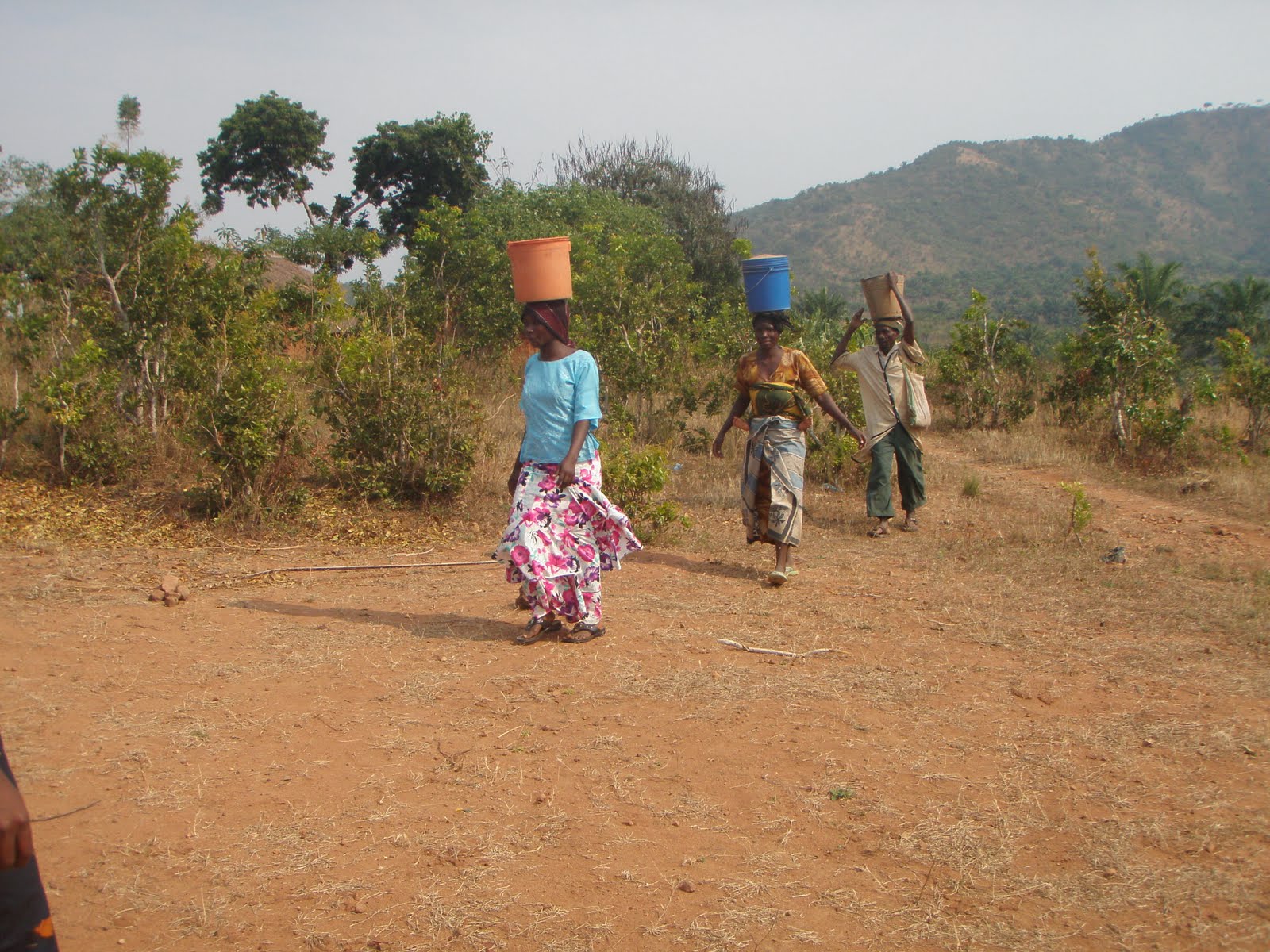
The sand buckets weigh a ton! The women roll up a scrap of kanga (the colorful fabric they wrap around their waists) and place it on their heads to soften the load a bit. Jane gave me a piece for my head. I couldn’t get the bucket on my head without help – it’s that heavy! Once it was on my head, we walked single file up the single track trail back up the hill to add to the growing pile.

We only made about five trips before they were calling it a day. It was only 11am! I can’t say I was unhappy about quitting. My neck – not strong like theirs from a lifetime of carrying ‘to the head’ – was tired. I wondered if I could do damage by jumping in like this, but I felt fine the day after. I could never carry the sand without balancing the bucket with my hands. These rockstar women not only carried the sand without the help of their hands for support, but in the case of three women they did so with babies on their backs. I told Lucas they should have one woman or even a ‘bibi’ (grandma) babysit while they worked. He replied with a laugh (and his all too familiar response to many of my observations or comments) “Rai, this is African peoples. This is Africa.” haha - I adore my partner!!
After a few hours of work, the whole team was ready to head back to the village center to congregate in the tea houses (men) or prepare the lunch (women). For the rest of the day – would they work? No. I don’t get it, but I can’t exactly expect much more productivity when they are all working for free and working hard!
Many things about the way this has to be done puzzled me. It seemed so slow and tedious – one bucket or stone at a time, three hours a day, 30 hands on deck. It seemed to me that it would take years to get enough for the foundation. Lucas said as Isaya’s team begins the work, the villagers will continue to come with sand and stones. Pole Pole (Slowly, Slowly). My frustration that day came in part from the pain of hefting the sand on my head uphill and in part to the sight of the work being done so inefficiently and slowly. But, it'll happen and I'm sure I'll be pleasantly surprised by how well.
Before we all retired back to the village, one elder man – the grandpa helping the women work – pulled out his whistle. Everyone gathered around clapping as Grandpa danced a ‘happy’ dance to celebrate the work done and the chai to come. We all laughed and clapped when he finished. Then everyone wandered off in various directions into the trees, back to their homes or the village center (don’t blink – you might miss it.)
As the day was young and we were all tired, I decided to treat Lucas and the kids (Hindu, Musa, Saidi and Dibeit) to a thank you meal. The kids seldom get to go into Kigoma town from the village. We walked about an hour back to Kiganza where we piled into a tightly packed dala dala and headed straight to the ‘New Modern Café’ to share three plates of fish and rice. After filling our bellies – we walked another distance to the lake – to a part of Lake Tanganyika where the water is never more than 4 feet deep for quite a distance. The boys dropped to their shorts and Hindu and I made our way out fully clothed. Some other ‘watoto’ joined us and we all splashed around and laughed until it was time to get the kids home. Lucas saw them off at the dala dala station in town and I went back to my hotel where I slept 11 hours!


Subscribe to:
Posts (Atom)